Night Owl or Early Bird? How Your Brain's Internal Clock Could Be Your Secret Study Weapon
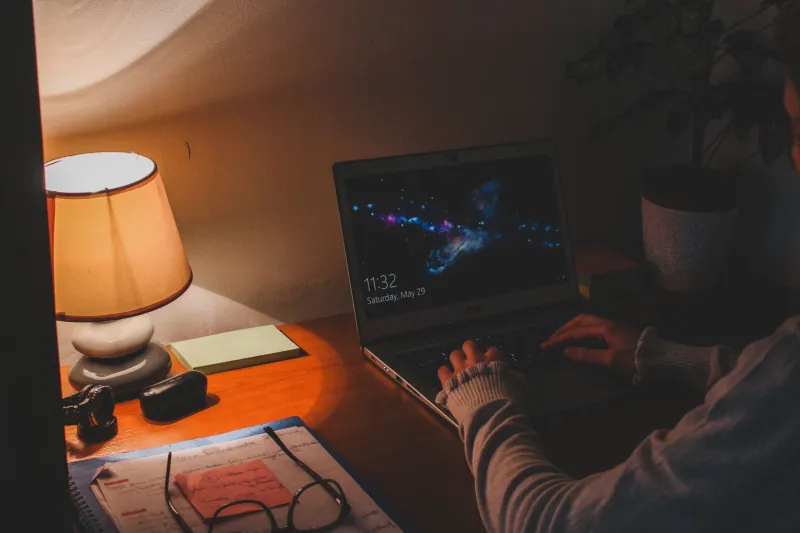
It's 11 PM. Your roommate or partner is already asleep. The house is quiet, your coffee is warm, and suddenly — that chemistry concept you've been wrestling with for a week just clicks. Sound familiar?
You're not imagining it. There's real neuroscience behind why late-night studying works so well for some people. And if you've ever felt guilty about pulling a late study session, this article is basically your permission slip — with a few important caveats.
Let's dig into what's actually happening inside your brain after dark.
Your Brain Has a Schedule (Whether You Like It or Not)
Deep inside your brain sits a tiny cluster of neurons called the suprachiasmatic nucleus, or SCN. Think of it as your body's master clock — it regulates your circadian rhythm, the roughly 24-hour biological cycle that controls everything from your body temperature to your alertness levels.
Here's the thing most people don't realize: your circadian rhythm doesn't just affect when you feel sleepy. It directly influences how plastic — meaning how adaptable and receptive — your brain is at any given hour. Brain plasticity is essentially your brain's ability to form new connections, and it's the foundation of learning.
Research from institutions like Harvard Medical School has shown that cognitive performance, working memory, and even abstract reasoning all fluctuate throughout the day based on your internal clock. For some people, these functions peak in the morning. For others, they hit their stride somewhere between 9 PM and midnight.
Enter: Your Chronotype
You've probably heard the terms "night owl" and "early bird," but the scientific term is chronotype. Your chronotype is essentially your genetically influenced preference for when you feel most alert and energized.
Researchers typically break chronotypes into three broad categories:
- Morning types (larks): Peak alertness in the early morning, mental fatigue sets in by early evening
- Evening types (owls): Slow to start, but hit peak cognitive performance in the late evening
- Intermediate types: The majority of people, falling somewhere in the middle
Here's where it gets interesting for science learners specifically. A 2019 study published in Science Advances analyzed the sleep patterns and academic performance of nearly 500 college students. The results? Students whose class schedules aligned with their natural chronotype performed significantly better — not because they were smarter, but because their brains were more receptive to learning during those hours.
If you're a natural night owl forced to attend 8 AM biology lectures, you're essentially asking your brain to absorb complex information while it's still in low-power mode. That's a tough ask.
What Melatonin Is Actually Doing to Your Learning
Most people think of melatonin as the "sleep hormone," and that's fair — but it's doing a lot more than just making you drowsy. As melatonin levels rise in the evening, your brain begins shifting into a different operational mode. Stress hormones like cortisol drop. Neural noise — that constant background mental chatter — quiets down.
For many learners, this creates what neuroscientists call an optimal "signal-to-noise" ratio for encoding new information. Distractions feel less intrusive. Focus comes more naturally. Complex ideas that felt overwhelming at 2 PM start to feel approachable.
This is also why the hours right before sleep are considered prime time for memory consolidation. During sleep — particularly during slow-wave and REM cycles — your hippocampus essentially replays the information you studied and transfers it into long-term memory storage. If you study something meaningful right before bed, your brain has a head start on filing it away properly.
The Real Risk: Sleep Debt Is a Learning Killer
Before you set a midnight alarm and declare yourself a dedicated night-owl scholar, there's a critical flip side to all of this.
Studying late only works if you're still getting enough sleep. Sleep deprivation — even mild, chronic sleep debt — is one of the most well-documented enemies of learning and memory. A 2021 study from UC Berkeley found that even one night of poor sleep reduced the brain's ability to form new memories by up to 40%.
The goal isn't to sacrifice sleep for study time. The goal is to shift your most cognitively demanding study sessions to the window when your brain is naturally sharpest — whether that's 10 PM or 6 AM — and protect your sleep accordingly.
How to Actually Build a Chronotype-Aligned Study Schedule
Okay, so how do you put all of this into practice? Here's a simple framework we use in our courses at Learn With Abinash:
Step 1: Identify your chronotype. Spend one week — ideally during a break or weekend when you have no fixed obligations — paying attention to when you naturally feel most alert and mentally sharp. Don't force it. Just observe. That window is your golden hour for learning.
Step 2: Assign subject complexity to your peak window. Save your hardest science material — calculus, organic chemistry, physics problem sets — for your peak hours. Use your lower-energy periods for reviewing notes, watching tutorial videos, or doing lighter reading.
Step 3: Create a pre-study wind-down ritual. If your peak window is in the evening, set up your environment intentionally. Dim the lights slightly (this actually supports melatonin production without making you sleepy), put your phone on Do Not Disturb, and give yourself 10 minutes of quiet before diving into material.
Step 4: End with a review, not a start. In the 20–30 minutes before you actually go to sleep, briefly review the key concepts you studied. Don't introduce new material — just revisit what you covered. This primes your brain to consolidate that information during the sleep cycles that follow.
Step 5: Protect your sleep window like it's sacred. Whatever schedule you build, make sure you're still hitting 7–9 hours. No amount of circadian optimization compensates for chronic sleep deprivation.
The Bottom Line
Science learning isn't one-size-fits-all, and neither is your brain. The idea that you must study in the morning to be a serious student is honestly outdated. What matters is understanding your own biology and working with it, not against it.
At Learn With Abinash, we believe learning should be personal — not just in the subjects you choose, but in how and when you engage with them. Understanding your chronotype is one of the simplest, most evidence-backed tools you can use to get more out of every study session.
Your brain is already doing incredible things while you sleep. The smartest thing you can do is give it the right information to work with.