Stop Copying Everything Down — Your Brain's Retrieval System Works Nothing Like a Filing Cabinet
Picture the last time you took notes in a lecture or while reading a textbook. Chances are, you were scribbling fast, trying to capture as much as possible, maybe even color-coding your highlighters like you had a system. It felt productive. It looked like learning.
But here's the uncomfortable truth neuroscience keeps trying to tell us: that approach might be quietly sabotaging the one thing notes are supposed to help you do — find the information again when it actually matters.
Your Brain Doesn't Store Information Like a Google Drive
Most of us unconsciously treat our memory like a hard drive. You put something in, you pull it back out. Notes are just the backup copy. Makes sense, right?
Except your brain doesn't work that way at all.
Memory is reconstructive, not reproductive. When you try to recall something, your brain doesn't retrieve a saved file — it rebuilds the memory from scattered fragments, using context, emotion, prior knowledge, and associations as the scaffolding. Think of it less like a filing cabinet and more like a search engine that ranks results based on relevance, connection, and how often you've run that particular search before.
This has massive implications for how you take notes, because the act of note-taking isn't just recording — it's indexing. And if your indexing method doesn't match how your brain actually retrieves information, you've basically built a library where none of the books are in the right section.
The Problem with Transcription-Style Notes
When students furiously copy down everything a professor says, something counterintuitive happens. A 2014 study from Princeton and UCLA — one that's been widely discussed in education circles — found that students who took notes by hand outperformed laptop users on conceptual questions, even though laptop users wrote significantly more. The reason? Typing encourages verbatim transcription, which actually reduces the cognitive processing needed to create strong memory traces.
But here's the part that often gets left out of that conversation: even handwritten notes can fall into the same trap if you're just trying to capture everything. The problem isn't the medium. It's the mindset of recording rather than processing.
When you're in transcription mode, your brain is essentially in passive relay — information comes in, words go out, and deep encoding barely happens. The retrieval cues you need later? They never got built in the first place.
What the Cornell Method Gets Right (and Where It Falls Short)
The Cornell note-taking system — developed at Cornell University in the 1950s — has held up surprisingly well against modern neuroscience. The structure is simple: a narrow left column for cues and questions, a wide right column for notes, and a summary section at the bottom.
What makes it work is the cue column. After a lecture, you're supposed to go back and write questions or keywords that prompt retrieval of the notes beside them. That step is essentially forcing you to build retrieval cues — exactly what your brain's search engine needs to find information later.
The weakness? Most students skip that review step entirely, which turns the Cornell method into just a slightly fancier version of regular notes. The magic is in the reconstruction, not the format.
Why Sketching and Visual Notes Hit Different
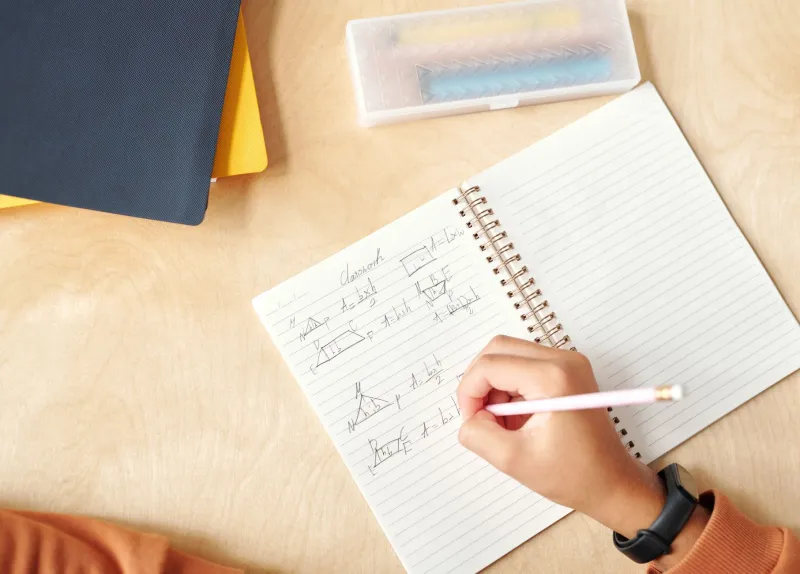
Here's where things get interesting. Research on the "picture superiority effect" consistently shows that information paired with visuals is recalled dramatically better than words alone. When you sketch a concept — even badly, even with stick figures — you're forcing your brain to translate the information rather than just transcribe it.
That translation process is the key. Every time your brain has to work to represent an idea in a new form, it builds another retrieval pathway. You're not just storing the concept once; you're creating multiple entry points for your mental search engine to find it later.
Sketch-noting, mind mapping, and even simple diagrams work because they externalize the relationships between ideas, not just the ideas themselves. And relationships are exactly what your hippocampus — the brain's indexing hub — uses to organize long-term memory.
The Counterintuitive Power of Minimal Notes
This might be the hardest sell: sometimes the best notes are almost no notes at all.
When you constrain yourself to writing only the single most important idea from a section, something interesting happens cognitively. You have to actually decide what matters most, which requires comprehension, not just attention. That decision-making process creates a stronger memory trace than passively writing everything down.
Try this: after reading a page or listening for ten minutes, close your notes and write one sentence — in your own words — that captures the core idea. It's uncomfortable. It feels like you're losing information. But you're actually doing the opposite: you're forcing your brain to compress and prioritize, which is exactly how durable memories get formed.
Building Notes Your Brain Can Actually Search
So what does good note-taking actually look like through the lens of retrieval science? A few principles that hold up:
Write questions, not just answers. Your brain retrieves information better when it's stored in response to a question. Frame your notes as answers to questions you'd actually ask yourself later.
Use your own words. Paraphrasing forces processing. Processing builds retrieval cues. Retrieval cues mean you can find it when the exam hits.
Leave deliberate gaps. Counterintuitive but true — notes that prompt you to reconstruct missing pieces during review are more effective than notes that give you everything. Incomplete information activates your brain's curiosity systems and drives deeper encoding.
Connect new ideas to things you already know. Explicitly write the connection: "This is like..." or "This is the opposite of..." Those links are your brain's hyperlinks — they make retrieval faster and more reliable.
The Bottom Line
Your brain's retrieval system is sophisticated, associative, and deeply contextual. It's not looking for the most complete notes — it's looking for the best cues. The goal of note-taking isn't to create a transcript you can re-read. It's to plant the mental anchors your brain needs to reconstruct understanding on demand.
Take fewer notes. Make them weirder. Ask more questions. Sketch things out, even badly. And for the love of your GPA, stop trying to write down everything.
Your brain already has a powerful search engine built in. Your job is just to give it something worth finding.